What is “personal brand” really?
I use the term personal brand cautiously.Too often it is used to describe an external image, packaging, or a self-presentation strategy. And this is usually how people think about personal branding. In my understanding, a personal brand is neither an image nor a message. I like Jeff Bezos’ definition: “Your personal brand is what people say about…
I use the term personal brand cautiously.
Too often it is used to describe an external image, packaging, or a self-presentation strategy. And this is usually how people think about personal branding.
In my understanding, a personal brand is neither an image nor a message.
I like Jeff Bezos’ definition:
“Your personal brand is what people say about you when you’re not in the room.”
This phrase matters not because it is about reputation, but because it points to the systemic effect of a person’s presence. A personal brand is not what you communicate, but what remains in the system after contact with you: in people’s thinking, in their decisions, in their emotional state, in their mood after interacting with you (even through your social media messages), and in the aftertaste that is left.
Why a Personal Brand Is Needed
In the common understanding, a personal brand is about visibility, promotion, and recognition.
In my logic, it serves a different purpose.
A personal brand is needed for:
- internal clarity,
- coherence between who you are and how you show up,
- reducing the inner tension that arises when a person is “playing a role.”
I formulate it this way:
A strong personal brand requires a precise understanding and articulation of the core of one’s identity.
If this core is missing, any attempt to “build a brand” turns into constant effort. The person has to maintain an image, adapt, explain themselves, and prove who they are.
Following Your Own Footprints
Within systemic coaching and personal brand research, I use an approach I call “following your own footprints.”
I mean something very concrete by this:
stop inventing yourself and start recognizing yourself.
Most personal branding approaches begin with questions like:
- “Who do I need to be in order to…?”
- “What image do I need to create to…?”
My approach starts with a different question:
- “Where am I already most fully myself?”
We do not explore a desired image, but real, recurring footprints:
- how a person thinks,
- how they listen,
- how they hold complexity,
- how they influence the field,
- what effects they consistently create around them.
I formulate it this way:
Defining a personal brand must include the person’s specificity and complexity, as well as the underlying processes and patterns that make them who they are.
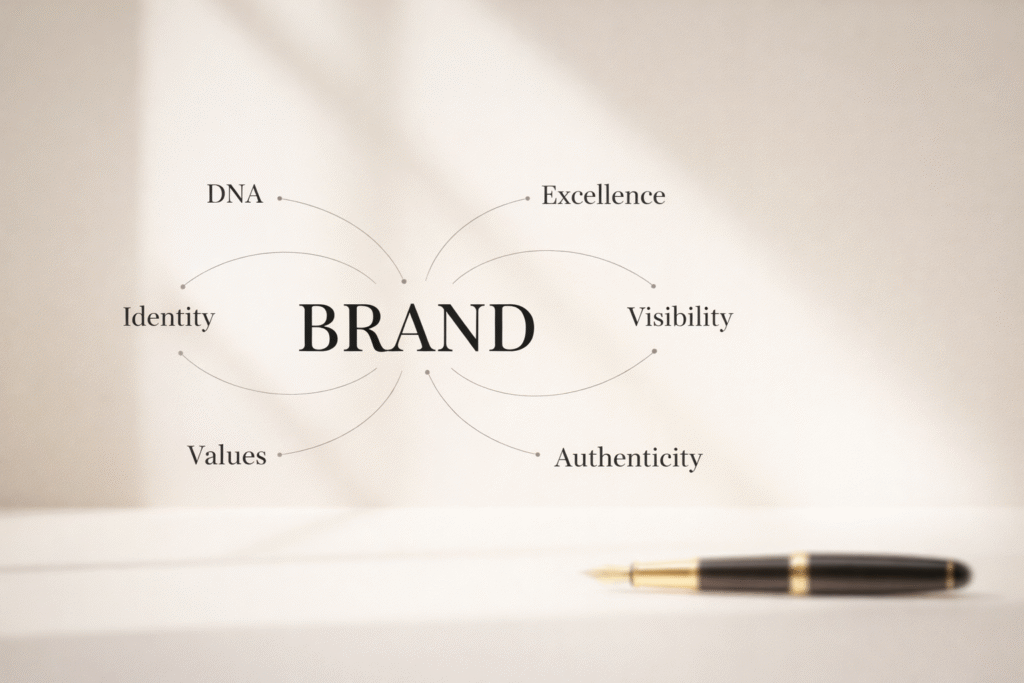
Personal Brand as “DNA”
Sometimes I say that a personal brand is a person’s DNA — not in a biological, but in a systemic sense.
It is what reproduces itself:
- across different roles,
- in different contexts,
- in different interaction formats.
If a brand is DNA, then it:
- does not require constant control,
- shows up naturally,
- makes a person recognizable without effort.
What We Actually Research in the Process
In my work with personal branding, we do not start with channels, texts, or positioning.
We start with researching identity and mastery.
- Role Identity
Not “what is your profession,” but what function you actually perform in the systems where you are present. - Mastery
Not abstract strengths, but concrete examples where your mastery has already shown itself.
We break it down into “ingredients”: attention, distinctions, tempo, and the way you enter a situation. - Uniqueness as an Effect
We look not only at how you see yourself, but also at what others consistently say about you — which qualities they notice and value. - Boundaries
A crucial point: what you want to offer the world — and what you do not.
A mature personal brand starts with a clear “no.” - Visibility
Only after this do we look at how the world can recognize you.
Channels are a consequence of identity, not the other way around.
The Language of a Personal Brand
We do not create slogans. We build a structure:
“I am …, who …, using …, in order to …”
This description should be such that the person reading it says:
“Yes, this is really me.”
If this sense of recognition is missing, the work is not finished.
Authenticity as a Tool for Trust
In my approach, authenticity is not a moral principle or a value in itself.
It is a practical tool for trust.
When a person stays close to themselves and their values:
- their actions become consistent,
- their presence becomes stable,
- their influence becomes calm and reliable.
I often formulate it this way:
To define how you want to be recognized in the world, while staying very close to who you are and what matters to you.
How My Approach Differs from the Market
- We do not build an image. We clarify identity.
- We work with behavioral patterns, not slogans.
- We create recognizability as a consequence of inner coherence.
What the Client Ultimately Gains
After this work, the client has:
- a precise self-description they genuinely recognize themselves in;
- clarity about their contribution;
- boundaries that reduce inner tension;
- natural recognizability without the need to “sell themselves”;
- a calmer and more integrated presence.
On this basis, it then becomes easy to formulate marketing messages for others and to engage in any visibility or promotion activities.
This is what I call a personal brand.